Feature flags vs. AB testing: when and how to use both for safer product rollouts
Product and engineering teams often use the terms feature flag and AB test interchangeably, but this is a structural mistake.
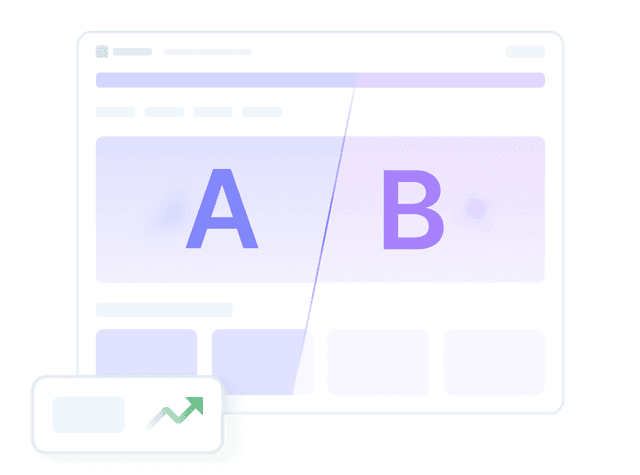
While both techniques involve routing users to different versions of your application, they serve entirely different purposes. Feature flags mitigate operational risk, while AB tests measure business impact.
Using a feature flag to measure conversion rates yields false insights, and using an AB testing tool to manage code deployments leads to a fragile architecture. To build a culture of safe, data-driven deployments, your team must understand the distinction and know exactly when to use each.
Test individual elements or full journeys with advanced AI-powered segmentation, great performance, no-code rollouts, and flicker-free experiments.
Feature flags: the operational kill switch
A feature flag (or feature toggle) is a mechanism that allows developers to enable or disable specific code paths or features without deploying new code. It decouples deployment from release.
- The goal: operational stability and risk mitigation.
- The use case: You are deploying a new backend microservice for your checkout. You hide it behind a feature flag. If the new service causes database timeouts in production, you toggle the flag off instantly. The application reverts to the old service with zero downtime and no emergency rollbacks.
- The metrics: Server load, latency, error rates, and uptime.
Feature flags can route traffic to a small percentage of users (a canary release), but they do not calculate statistical significance or measure user behavior. They simply answer the question: "Is this code breaking the system?"
AB testing: the business compass
An AB test is a controlled experiment designed to measure the impact of a change on user behavior.
- The goal: Measuring ROI and optimizing conversion.
- The use case: Your new checkout microservice is stable. Now, you want to know if the redesigned UI powered by that service actually increases revenue compared to the old design.
- The metrics: Conversion rates, average ticket value, lead generation, and statistical confidence.
A true AB testing platform answers the question: "Is this change driving business value?" To do this reliably, it requires a robust statistical model. For example, Croct uses a Bayesian engine to calculate the probability of a variation being the best option, allowing you to declare winners faster and with mathematical certainty.
The lifecycle of a safer rollout
The most sophisticated product teams do not choose between feature flags and AB tests. They use them sequentially to manage the entire lifecycle of a new feature.
1. The dark launch (feature flag)
You deploy the code to production, but keep the feature flag turned off for the public. You enable it only for internal IP addresses, or your QA team to test in the live environment.
2. The canary release (feature flag)
Once internal testing passes, you use the feature flag to expose the new feature to just 5% of your total traffic. You monitor your error logs and infrastructure. If latency spikes, you turn it off. If it holds up, you are ready to measure.
3. The experiment (AB test)
Now that you know the feature is technically stable, you need to know if it is profitable. You transition from a flag to an AB test. You split your target audience evenly between the control (old version) and the variant (new version). The Bayesian engine tracks conversion events until you reach statistical significance.
4. The full rollout (feature flag)
The data confirms your new feature increases conversions by 12%. You end the AB test and use your feature flag to route 100% of traffic to the winning experience. Finally, your developers remove the old code and the flag in the next sprint to prevent technical debt.
From personalization and experimentation to content and data management, we have all you need to deliver better user experiences.

Why you need both in one platform
Historically, companies bought a developer-centric tool for feature flags and a separate marketing-centric tool for AB testing. This creates data silos and forces teams to duplicate targeting logic across different systems.
We built Croct to unify this workflow.
By combining native feature flagging with a Bayesian AB testing engine, Croct gives your engineering team the control they need to safely deploy code, while giving your product and growth teams the statistical rigor they need to measure impact. Everything happens server-side, ensuring zero flickering and maximum performance.
Launching features should not be a gamble. Create your free account and start rolling out products safely with Croct today.